

Teen Patti Basics
Teen Patti Boot Amount and Pot Limit: How the Pot Works
What is the boot amount in Teen Patti and how does the pot limit work? Understand entry stakes, how the pot grows and when a table stops.
Updated 3 October 2026
Platform Guides
Published 24 November 2026 · Updated 24 November 2026

Quick answer: yes. Most real-cash Teen Patti apps take a small cut — usually called a table fee, service charge, or commission — out of the pot before crediting the winner's balance, so the amount you actually receive is a little less than the pot you watched grow during the hand. This fee is set by the app itself. It is not a government tax, and it is separate from the GST charged on deposits and the TDS withheld from net winnings, covered elsewhere on this site.
Teen Patti apps borrow the concept directly from poker's "rake": a portion of each pot that the house keeps for running the table, rather than paying out 100% of what players put in. Apps use inconsistent labels for it — "table fee," "service charge," "platform fee," "commission" — and some don't label it at all, folding it quietly into the final payout number instead of showing it as a separate line item.
A real-cash card-game app needs a revenue source beyond advertising, and a per-hand fee on the pot is the most direct one: it scales naturally with how much money moves through the table, rather than depending on a flat subscription or a fixed entry charge. This is a normal business mechanic across the category, disclosed or not — not evidence of anything irregular by itself.
| Step | What happens |
|---|---|
| Boot paid | Every player's boot forms the starting pot |
| Betting rounds | Chaal and raises grow the pot further |
| Show / showdown | The winning hand is declared |
| Table fee deducted | The app deducts its commission from the final pot |
| Balance credited | The remainder lands in the winner's in-app balance |
| Withdrawal (separate step) | TDS may apply to net winnings — see our TDS explainer |
The table fee is the only deduction in that chain that the platform itself keeps. Everything after "balance credited" is a government-side deduction, not the app's.
Figures circulating for this kind of fee across real-money card-game apps commonly cite a low single-digit percentage of the pot, often somewhere in a 2%–5% range. That figure is not independently verified for any specific app named on this site, is not disclosed uniformly across the category, and can change without notice. Treat it as a general pattern to be aware of, not a number to plan a bankroll around.
| Deduction | Who keeps it | When it applies | What it's based on |
|---|---|---|---|
| Table fee / rake / commission | The app itself | Deducted from the pot at the end of a winning hand | The pot size for that hand |
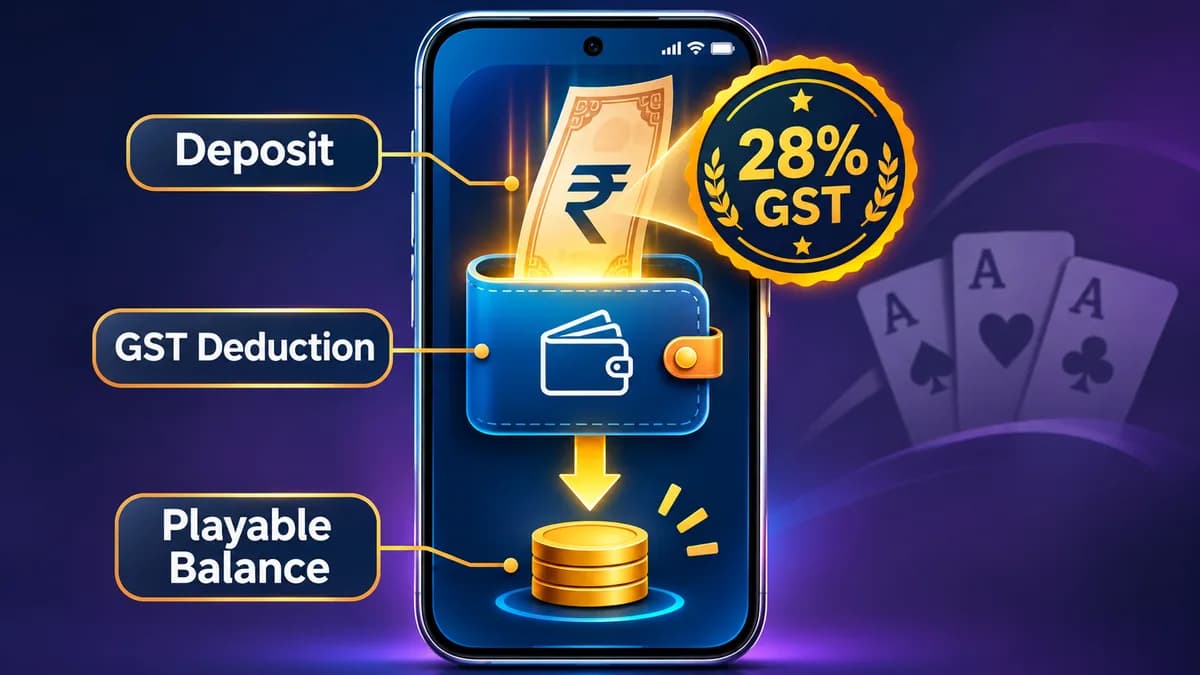
| GST | Government (collected by the platform) | At deposit/bet | 28% of the deposit or bet's face value — see our GST explainer |
| TDS | Government (withheld or self-declared) | On net winnings, typically at withdrawal | Net winnings over the applicable threshold — see our TDS explainer |
These three can all apply to the same session without being the same thing. A payout that looks "short" twice over — once at the table, once at withdrawal — usually reflects two unrelated deductions, not one miscalculated figure.
Any pot-odds math — including the thresholds in our betting strategy guide — is based on the pot as dealt, not on the smaller amount that actually lands in your balance after a table fee comes out. Your realistic win rate, in money terms, runs a little below the raw pot math, which is worth building into how big a bankroll edge you expect to come away with over a session.
18+ only. This page is educational and does not promise any outcome. See our responsible gaming page.
This article is informational only and is not legal or financial advice. This website is an independent directory: it does not operate games, take bets, or process payments. See our editorial policy for how content is researched and updated.
Teen Patti Basics
What is the boot amount in Teen Patti and how does the pot limit work? Understand entry stakes, how the pot grows and when a table stops.
Updated 3 October 2026

Platform Guides
Teen Patti real-cash apps share a common withdrawal pattern — KYC checks, minimums, processing claims. Here's what to verify before you rely on any of it.
Updated 18 October 2026
Legal and Industry Updates
Real-money Teen Patti deposits are commonly taxed under GST at 28% of the full deposit amount, not just platform commission. Here's how that differs from TDS. Not tax advice.
Updated 21 November 2026

Legal and Industry Updates
Net real-money Teen Patti winnings are commonly taxed via TDS at a flat rate, with no exemption threshold and no loss offset across sessions. Not tax advice.
Updated 19 November 2026