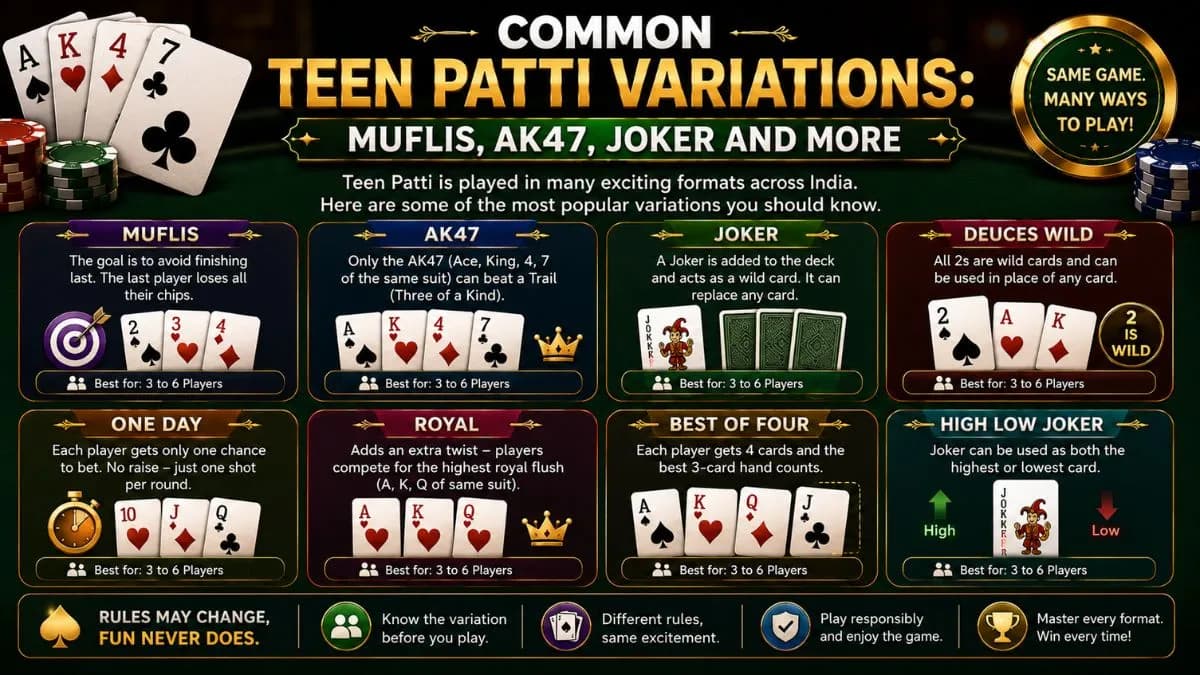
Quick answer: In AK47 Teen Patti, the cards A, K, 4 and 7 are wild cards in every suit. A wild card can stand in for any card to complete a trail, sequence or other hand, which makes strong hands much more common than in the standard game.
AK47 is one of the best-known Teen Patti variations, and the name is a clue to the rule itself: the letters and numbers A, K, 4, 7 are the wild ranks.
Where the name comes from
Read the four wild ranks together and you get "AK47". Each rank appears in four suits, so there are 16 wild cards in a 52-card deck. That is almost one card in three.
How wild cards work
A wild card takes whatever value gives its holder the best possible hand. For example:
- A-K-5: two wilds and a 5. The wilds become fives, giving a trail of 5-5-5.
- 7-9-9: one wild and a pair of nines. The wild becomes a nine, giving a trail of 9-9-9.
- 4-8-9: one wild (the 4) with an 8 and a 9. The wild becomes a 7 or a 10 to complete a sequence (7-8-9 or 8-9-10), or a 9 to make a pair. It is used as whichever gives the best hand.
- 4-7-6: two wilds (the 4 and 7) and a 6. Both wilds become sixes, giving a trail of 6-6-6.
What changes in play
Because 16 of 52 cards are wild, strong hands show up far more often.
| Effect | Result |
|---|
| Trails | Much more common |
| Pure sequences | More common |
| Weak hands | Rarer, and a plain high card is seldom enough |
| Strategy | Hands that feel strong in standard play become ordinary |
Betting, blind and seen play, packing and sideshows are unchanged. See blind vs seen for the betting basics.
Reading an AK47 showdown
Because the wild ranks are fixed, you can read any hand by counting wilds first.
| Hand | Wilds | Best hand it makes |
|---|
| A♣ K♦ 9♠ | 2 (A, K) | Trail of 9s |
| 7♥ 7♦ 2♣ | 2 (both 7s) | Trail of 2s |
| 4♠ 8♦ 9♦ | 1 (the 4) | Pure sequence (7♦-8♦-9♦) |
| 5♣ 6♣ 10♥ | 0 | Plain high card, 10-high |
The last row shows what a "natural" hand looks like in AK47. A hand with no wild cards and no pairing is now unusually weak, because most opponents will hold at least one wild.
How wilds affect the odds
36 of the 52 cards are not wild, so the chance of a three-card hand with no wild is about 32%. That means roughly two players in three hold at least one wild in a typical hand. That is why trails dominate showdowns, and why a pair that would be respectable in the standard game is often just a stepping stone here.
The practical result is that ties and near-ties between strong hands are common. Two players holding trails of different ranks is a normal event, and tie-break rules decide a great many pots.
Tie-breaks
When two players hold the same type of hand, such as two trails, many tables rank the natural hand (made with no wild card) above one built with wilds. Others compare by rank only. This is table-specific, so look for it in the table description.
Common beginner mistakes in AK47
- Forgetting the wilds are in every suit. There are four wild aces, four wild kings, four wild fours and four wild sevens.
- Treating a wild as a fixed card. A wild is whatever helps most at the show.
- Not checking the tie-break rule.
- Playing it like standard Teen Patti. A hand you would raise on in the standard game may be ordinary here. See common beginner mistakes.
Is AK47 the same everywhere?
The name is widely used, but local versions differ. Some tables add a rule that wilds cannot be used for a pure sequence, others rank natural trails above wild trails, and some add extra wilds. Treat the description above as the common core and the table rules as the final word. To try it without stakes, see how to play Teen Patti at home.
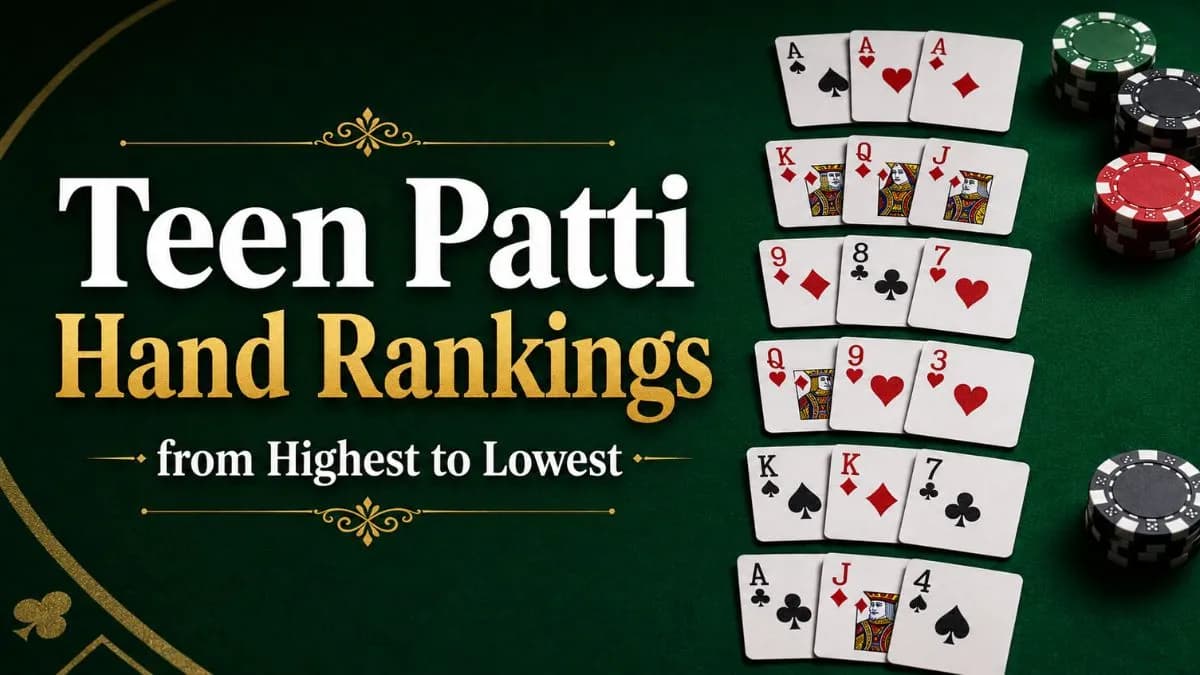
Compare AK47 with other styles in common Teen Patti variations, including Joker Teen Patti and Muflis. The ranking order stays standard, see trail vs pure sequence.
18+ only. Educational content.
This article is informational only and is not legal or financial advice. This website is an independent directory: it does not operate games, take bets, or process payments. See our editorial policy for how content is researched and updated.