
Teen Patti Basics
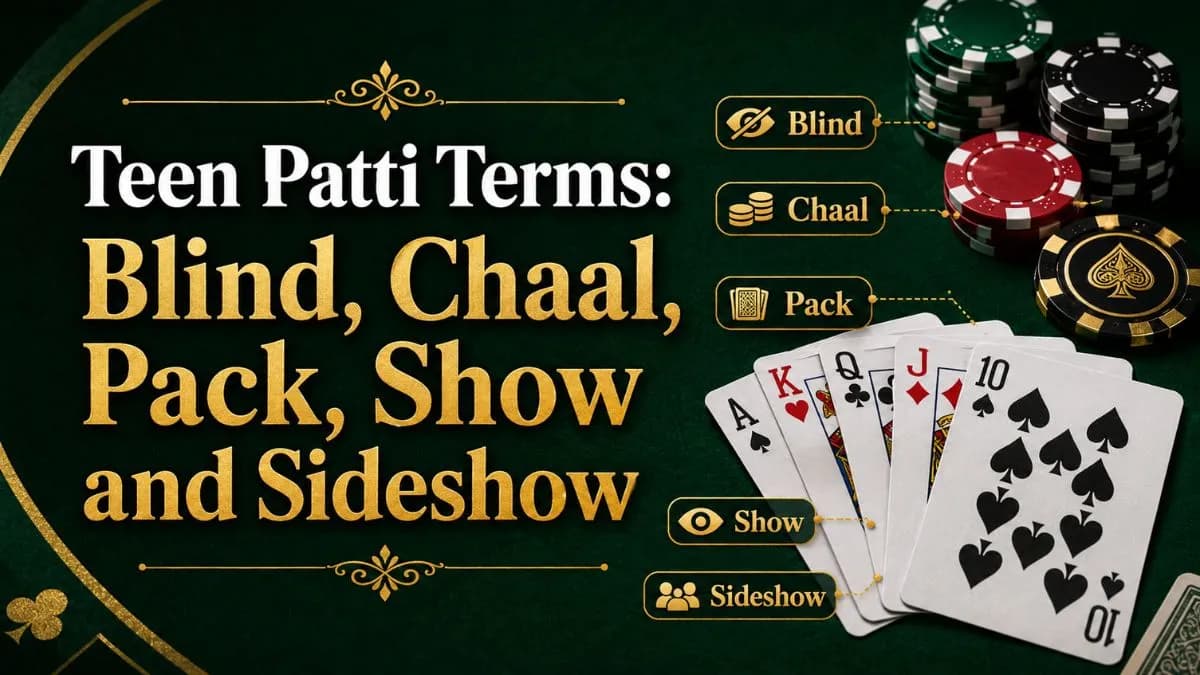
Teen Patti Terms: Blind, Chaal, Pack, Show and Sideshow
A plain-language glossary of Teen Patti's betting vocabulary — boot, blind, seen, chaal, pack, show, sideshow, and the phrases apps use for them.
Updated 17 July 2026
Teen Patti Basics
Published 2 October 2026 · Updated 2 October 2026

Quick answer: A blind player bets without looking at their three cards; a seen player has looked at them. In most Teen Patti rules, a blind player pays a smaller bet than a seen player, and a seen player pays double the current stake. Rules vary by table, so check them before you play.
Every Teen Patti hand starts the same way: three cards are dealt face down. Before your first real decision you have a choice that no other card game gives you so cleanly. You can look at your cards, or you can play without looking. That choice is the whole idea behind "blind" and "seen", and understanding it will make the rest of the game, from betting to showdowns, far easier to follow.
A player is blind when they have not looked at their cards. They are betting without information. Because they know nothing about their hand, most tables charge them a smaller bet to stay in. A blind player can also keep playing blind for several rounds, up to a table limit called the maximum blinds.
A player becomes seen the moment they look at their cards. From that point they decide with knowledge, but they pay for it: a seen player's bet is normally double the current stake. Only seen players can use certain options, most notably the sideshow.
The exact numbers depend on the table or app, but the common pattern looks like this. "Stake" means the current bet level that blind players pay.
| Player type | Typical bet (chaal) | Can ask for a sideshow? |
|---|---|---|
| Blind | 1× the current stake, with the option to raise to 2× | Usually no |
| Seen | 2× the current stake, with the option to raise to 4× | Yes |
For example, if the stake is 10, a blind player pays 10 (or raises to 20), while a seen player pays 20 (or raises to 40). You can learn how the starting pot is built in our guide to the boot amount and pot limit.
Looking at your cards is real information, and the game charges you for it. That is the core trade-off:
Neither is "correct". It is a choice about how much variance you are comfortable with.
The blind-or-seen decision is not made once. It comes back every turn, and the right feel for it changes with the size of the pot.
Remember that opponents read you in the same way. A player who stays blind through several large bets may be confident, bluffing, or simply playing for variance, and the table cannot tell which.
Most tables limit how many rounds a player may stay blind. This is the maximum blinds setting you will see in the lobby. When you reach it, you are normally required to look at your cards or pack. The rule exists to stop one blind player from dragging out a hand at the cheaper rate indefinitely. If you are learning the game, check this number first, because it tells you how long the cheaper option stays available.
Four players sit down with a boot of 10. Player A stays blind and bets 10. Player B looks at their cards, so they pay 20. Player C stays blind and pays 10. Player D looks, sees a weak hand, and packs (folds). In this round, two players are blind, one is seen and one has left. The next bet level is based on what the last player paid.
| If you… | You pay | You know | You can |
|---|---|---|---|
| Stay blind | Less | Nothing about your hand | Keep playing at the lower rate |
| Look (go seen) | More | Your three cards | Fold early, raise, or request a sideshow |
Neither option changes the odds of the hand you were dealt. Your cards are fixed from the moment they are dealt. Looking at them only changes what you know and what you pay. For the odds of each hand, see our probability guide.
Playing blind is a variance choice, not a skill move. Decide your spending limit before you start, whether you play blind or seen, and never play with money you need for anything else. For more on setting limits, read our responsible gaming guide. To learn all the terms you will hear at the table, see Teen Patti terms explained and the full Teen Patti rules.
18+ only. This page is educational and does not promise any outcome. See our responsible gaming page.
This article is informational only and is not legal or financial advice. This website is an independent directory: it does not operate games, take bets, or process payments. See our editorial policy for how content is researched and updated.
Teen Patti Basics
A plain-language glossary of Teen Patti's betting vocabulary — boot, blind, seen, chaal, pack, show, sideshow, and the phrases apps use for them.
Updated 17 July 2026
Rules and Hand Rankings
The complete rules of Teen Patti: the boot, dealing, blind and seen play, chaal, sideshow, and show — explained step by step for new players.
Updated 17 July 2026