

Rules and Hand Rankings
Teen Patti Hand Rankings from Highest to Lowest
All six Teen Patti hand ranks explained with examples: trail, pure sequence, sequence, colour, pair, and high card — and how ties break.
Updated 17 July 2026
Rules and Hand Rankings
Published 17 July 2026 · Updated 17 July 2026
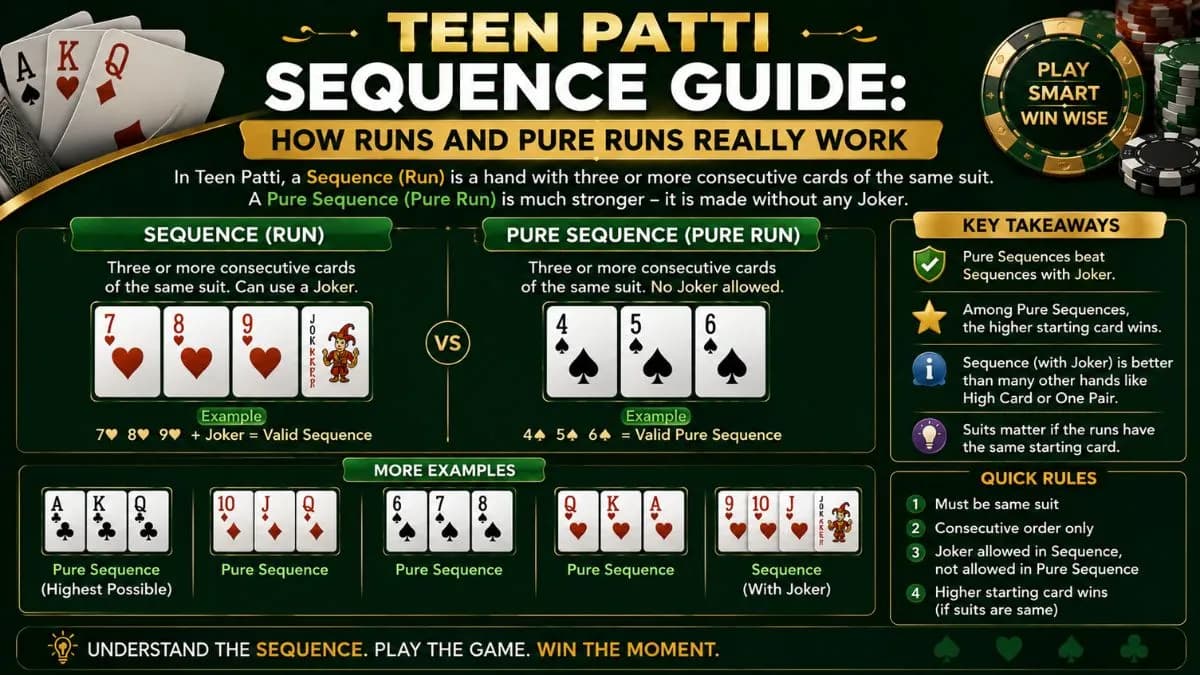
Two of Teen Patti's six hand ranks are runs: the pure sequence (three consecutive cards in one suit) and the sequence (three consecutive cards in mixed suits). They are also where most table disputes start — what the ace can do, whether K-A-2 counts, why a run beats a flush at all. Our hand rankings guide places these hands in the full order; this guide settles the details.
A sequence is three cards of consecutive rank — 5-6-7, 9-10-J, J-Q-K — in any mix of suits. Suits are irrelevant to whether the run exists; they decide only whether it is pure. Counting the ace's two positions, there are exactly twelve possible runs, from A-2-3 at one end to A-K-Q at the other.
The ranks do not wrap around: K-A-2 is not a run, just an ace-high hand. The ace can sit at the top of a run or at the bottom, never in the middle.
When all three cards of a run share a suit — 9-10-J of hearts — the hand is a pure sequence, poker's straight flush, and it ranks second only to a trail. The same run in mixed suits is a plain sequence, sitting below trail and pure sequence but above colour.
The gap between the two matters at a show: any pure sequence beats any plain sequence. Pure 2-3-4 of clubs beats mixed A-K-Q. Rank class is compared first; only when both hands sit in the same class do the cards themselves get compared.
In the most widely used convention, A-K-Q is the highest run and A-2-3 the second highest, with K-Q-J third and the rest descending to 4-3-2 at the bottom. That A-2-3 outranks K-Q-J surprises players coming from poker, where the ace-low straight is the weakest — but the convention is standard across most Teen Patti tables and apps.
It is not universal, though. Some rule sets rank A-2-3 as the lowest run instead. This is exactly the kind of detail worth confirming on an app's rules screen before real chips move, because it changes who wins a run-against-run show. That check applies equally to every app in our games directory.
Poker players expect a flush to beat a straight; Teen Patti reverses this, and the reversal is pure arithmetic. There are 22,100 possible three-card hands. Runs account for 768 of them (twelve runs, each in 4 × 4 × 4 suit combinations), of which 48 are pure. Same-suit hands are more plentiful: 1,144 in total, of which the same 48 are pure sequences, leaving 1,096 plain colours.
So a plain sequence turns up in roughly 3.3% of deals and a plain colour in about 5% — sequences are the rarer hand, and Teen Patti's rankings simply follow rarity. Five-card poker runs the same logic to the opposite conclusion: with five cards, straights outnumber flushes, so the flush ranks higher. Neither game is being eccentric; both are counting.
When two sequences (or two pure sequences) meet, compare the runs by their top card: 10-J-Q beats 5-6-7, and J-Q-K beats 10-J-Q. The two ace runs sit above all of that in the standard convention — A-K-Q first, A-2-3 second.
Suits never break ties. If two players hold the same run in different suit mixes, the hands are equal, and the show's tie rule decides the pot — in most rule sets the player who paid for the show loses a tie, as our rules guide covers. A pure sequence against a plain one of the same run is not a tie at all; the pure hand wins by class.
Any sequence, pure or plain, arrives about once every 29 deals; the pure sequence alone shows up about once in 460 — genuinely rare, though not trail-rare. What makes runs valuable in play is the other side of the arithmetic: a plain sequence beats roughly 96% of all dealt hands, since high cards, pairs, and colours together make up almost everything the deck produces.
The practical read: a seen player holding any run is ahead of nearly every hand at the table and can bet with conviction — while remembering that the two hands that beat a plain sequence, pure sequence and trail, are exactly what an opponent's unshakeable confidence might be announcing.
This article is informational only and is not legal or financial advice. This website is an independent directory: it does not operate games, take bets, or process payments. See our editorial policy for how content is researched and updated.
Rules and Hand Rankings
All six Teen Patti hand ranks explained with examples: trail, pure sequence, sequence, colour, pair, and high card — and how ties break.
Updated 17 July 2026
Game Comparisons
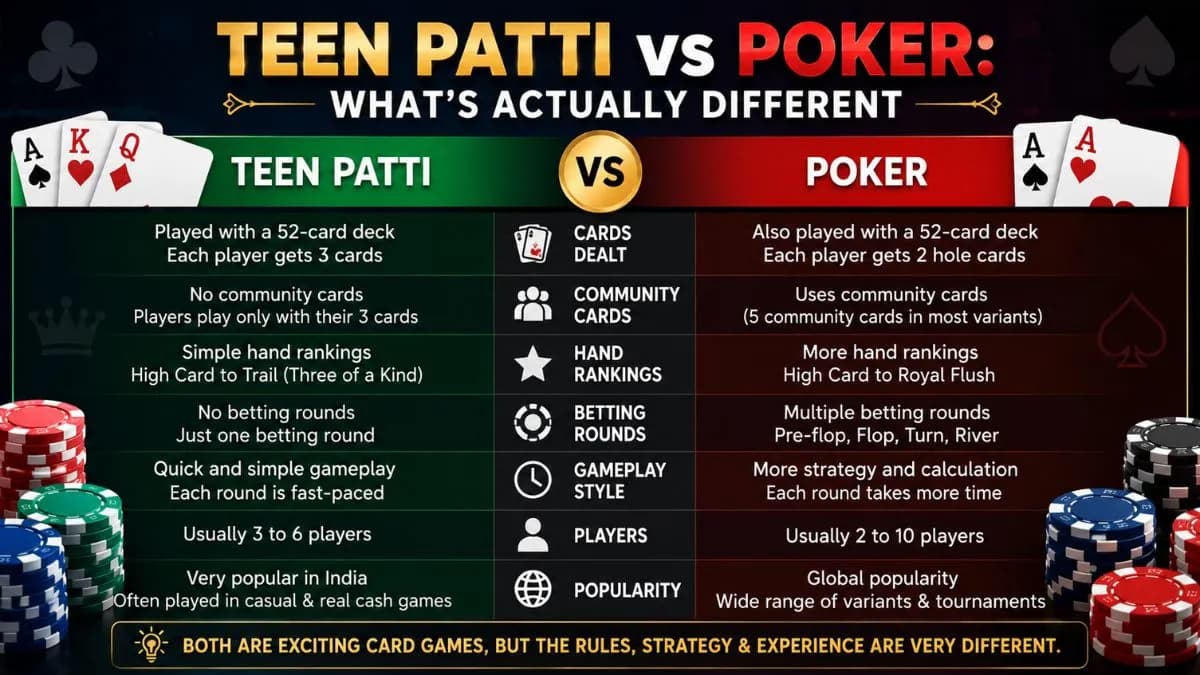
Teen Patti is often called Indian poker, but the games differ in hand size, betting structure, information, and pace. A side-by-side comparison.
Updated 17 July 2026
Teen Patti Basics
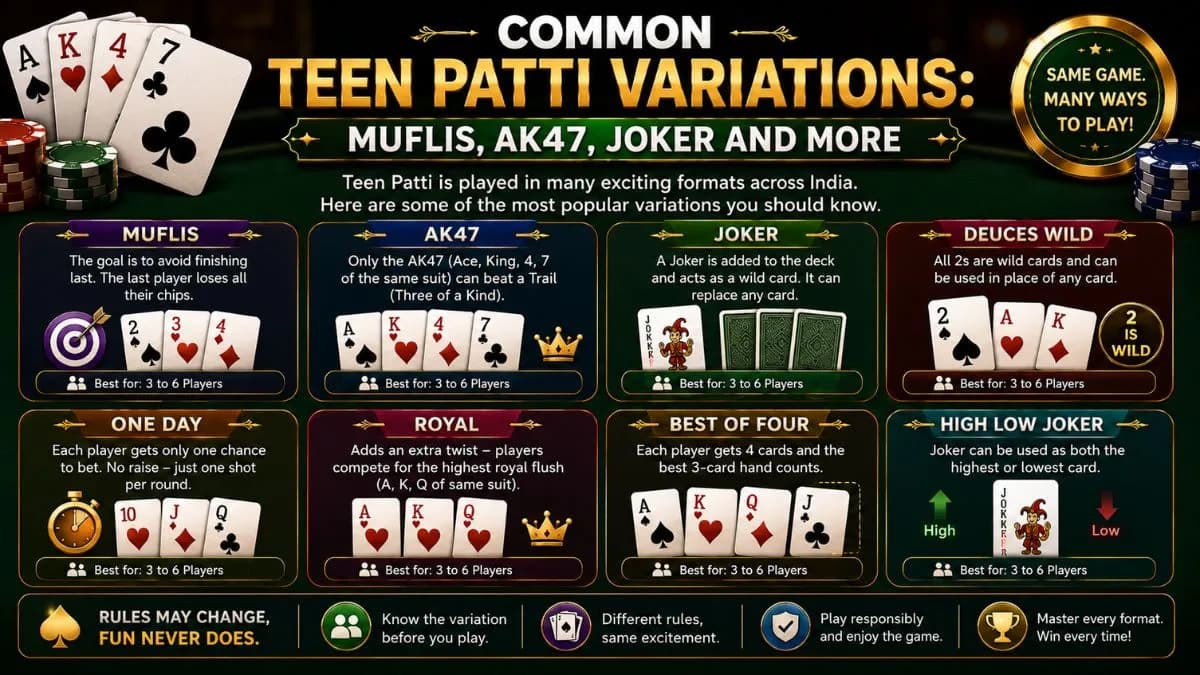
The best-known Teen Patti variants — Muflis, AK47, joker rounds, Lowest Card Joker, Best of Four, and 999 — and how each one changes the base game's odds.
Updated 17 July 2026