

Rules and Hand Rankings
Teen Patti Rules Explained
The complete rules of Teen Patti: the boot, dealing, blind and seen play, chaal, sideshow, and show — explained step by step for new players.
Updated 17 July 2026
Teen Patti Basics
Published 17 July 2026 · Updated 17 July 2026

Teen Patti — literally 'three cards' in Hindi — is a betting card game played with a standard 52-card deck, usually by three to six players. Each player receives three cards face down, and the game revolves around betting on whose hand ranks highest. It has been a fixture of Indian households for generations, especially around Diwali, when playing cards is considered auspicious in many families.
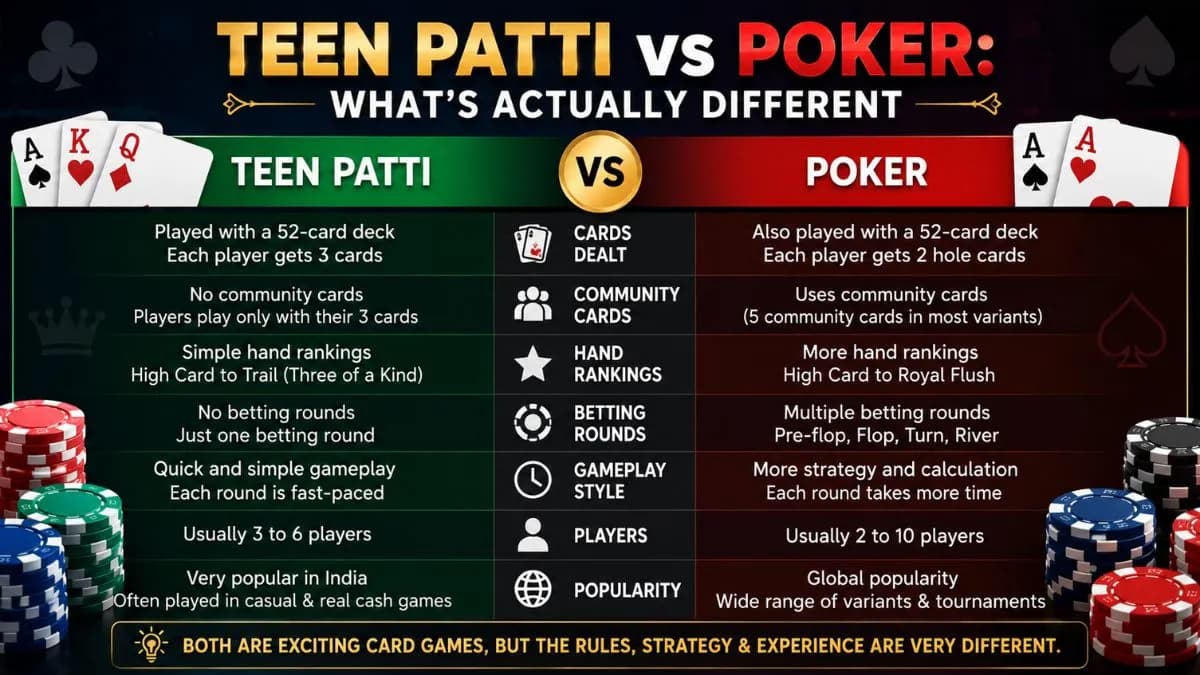
The game is often called Indian poker, and the comparison is fair as far as it goes: both are vying games where players bet in rounds and the best hand wins if things reach a showdown. But Teen Patti is older in its lineage — it descends from the British game three-card brag — and its rhythm is quite different from poker's, faster and more direct.
A round of Teen Patti is simple in outline. Everyone puts a small agreed stake — the boot — into the pot. The dealer gives each player three cards face down. Betting then moves around the table: on your turn you either put in chips to stay in the round or fold (pack) and give up your cards.
What makes the game distinctive is the choice to play blind. A blind player bets without looking at their cards, and in exchange pays less to stay in than a player who has looked (a seen player). This creates the game's central tension — a confident blind player can pressure seen players into folding decent hands.
The round ends when only one player remains, who wins the pot without showing anything, or when two remaining players go to a show and compare hands. Highest-ranking hand takes the pot.
From strongest to weakest: three of a kind (trail or set), straight flush (pure sequence), straight (sequence), flush (colour), pair, and high card. Aces are high, and the rarest hands beat the more common ones — with three cards, a trail comes along very rarely, which is why it sits at the top. Our hand rankings guide walks through each with examples.
Alongside the traditional home game, Teen Patti now exists in a crowded world of mobile apps — some free-to-play with virtual chips, others involving real money. The two experiences look similar on screen but are very different products, legally and financially. Real-money play is regulated differently across Indian states, and the apps offering it vary enormously in transparency and quality.
That variety is the reason this directory exists. If you are exploring Teen Patti apps, learn the game itself first — it costs nothing at a family table — and read our platform review guide before trusting any app with money or personal information.
This article is informational only and is not legal or financial advice. This website is an independent directory: it does not operate games, take bets, or process payments. See our editorial policy for how content is researched and updated.
Rules and Hand Rankings
The complete rules of Teen Patti: the boot, dealing, blind and seen play, chaal, sideshow, and show — explained step by step for new players.
Updated 17 July 2026

Rules and Hand Rankings
All six Teen Patti hand ranks explained with examples: trail, pure sequence, sequence, colour, pair, and high card — and how ties break.
Updated 17 July 2026
Game Comparisons
Teen Patti is often called Indian poker, but the games differ in hand size, betting structure, information, and pace. A side-by-side comparison.
Updated 17 July 2026