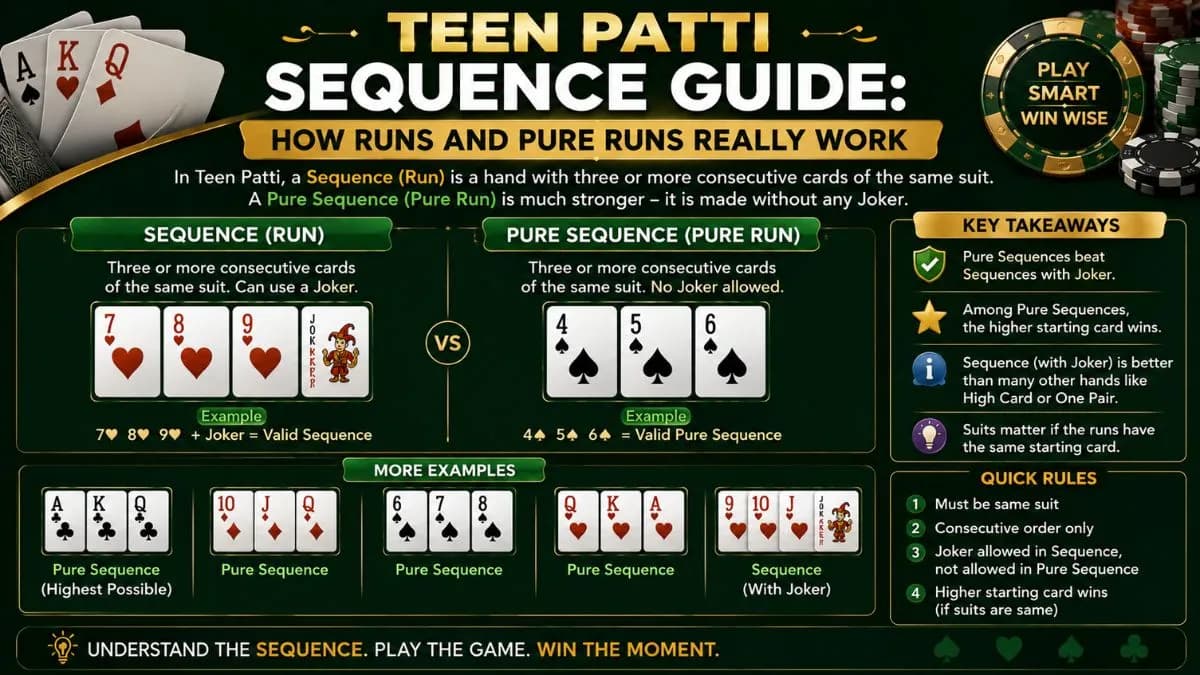
Quick answer: Yes, A-2-3 is a valid sequence in Teen Patti. In most standard rules it is the second-highest sequence, just below A-K-Q, because the ace counts as both high and low. Some tables rank it as the lowest sequence, so confirm the house rule before you play.
Few rules cause as many table arguments as the A-2-3 sequence. This guide explains how it normally works and why it differs.
The ace works both ways
In Teen Patti the ace can be high or low:
- High: Q-K-A (or A-K-Q) is a valid sequence.
- Low: A-2-3 is a valid sequence.
What the ace cannot do is wrap around. A combination like K-A-2 is not a sequence.
Typical ranking of sequences
Under the most common rule, sequences rank like this from highest to lowest:
- A-K-Q
- A-2-3
- K-Q-J
- Q-J-10
- J-10-9
- …continuing down to 4-3-2 (the lowest)
So A-2-3 sits just below A-K-Q, which surprises many new players who expect it to be the weakest.
All twelve sequences, in order
Here is every possible three-card sequence under the common rule. It is useful as a reference card to keep at the table.
| Rank | Sequence | Note |
|---|
| 1 | A-K-Q | Highest sequence |
| 2 | A-2-3 | Ace counted low |
| 3 | K-Q-J | |
| 4 | Q-J-10 | |
| 5 | J-10-9 | |
| 6 | 10-9-8 | |
| 7 | 9-8-7 | |
| 8 | 8-7-6 | |
| 9 | 7-6-5 | |
| 10 | 6-5-4 | |
| 11 | 5-4-3 | |
| 12 | 4-3-2 | Lowest sequence |
At a table that ranks A-2-3 lowest, it moves to position 12 and every other sequence moves up one place. The twelve sequences themselves do not change. Only the position of A-2-3 does.
Why tables differ
Teen Patti is a traditional game with no single governing body, so rules are agreed locally. For A-2-3 you will find two main conventions:
| Convention | A-2-3 ranks… |
|---|
| Common standard | Second-highest sequence |
| Alternative | Lowest sequence |
This matters in close showdowns, because the same two hands can produce different winners at different tables.
A worked showdown
Two players reach a show. Player A holds A♣ 2♦ 3♠. Player B holds K♥ Q♥ J♦.
- Common rule (A-2-3 second): A-2-3 outranks K-Q-J, so Player A wins.
- Alternative rule (A-2-3 lowest): K-Q-J outranks A-2-3, so Player B wins.
The same cards produce opposite winners. This is exactly why disputes arise and why agreeing the rule beforehand matters.
Neither convention is a mistake. Families, regions and apps each settled on their own, and both have long traditions. When you join an online table, treat the A-2-3 rule as part of the table setup, like the boot or the pot limit, and read it before you bet. If an app does not state it, look in the help or game rules section. Our common variations guide lists other points where tables differ.
The pure version
If the three cards of an A-2-3 are also the same suit, it is a pure sequence, which beats any ordinary sequence. See trail vs pure sequence for how the top hands compare.
How A-2-3 compares with other hands
A-2-3 only matters when you compare it against hands of its own type or the types just above and below it.
- Against a pair or colour: A-2-3 wins. Any sequence beats a pair or a colour.
- Against a pure sequence: A-2-3 loses. A pure sequence of any kind outranks every ordinary sequence.
- Against a trail: A-2-3 loses. Nothing beats a trail except a higher trail.
Only 12 sequences exist, and A-2-3 in any suits arises in only 64 combinations (60 ordinary and 4 pure), about 0.29% of hands. See the probability guide for the full table.
A quick way to remember it
Think of the ace as a card that "touches" both ends of the deck. Q-K-A closes the top and A-2-3 starts the bottom, but the run never goes round the corner. If you can say "ace can start or finish, never sit in the middle", you will not mistake K-A-2 for a sequence.
How to avoid disputes
- At home, agree the A-2-3 rule before the first hand.
- Online, read the table rules or help page. Do not assume.
- If an app does not state it, ask support before playing.
This article is informational only and is not legal or financial advice. This website is an independent directory: it does not operate games, take bets, or process payments. See our editorial policy for how content is researched and updated.