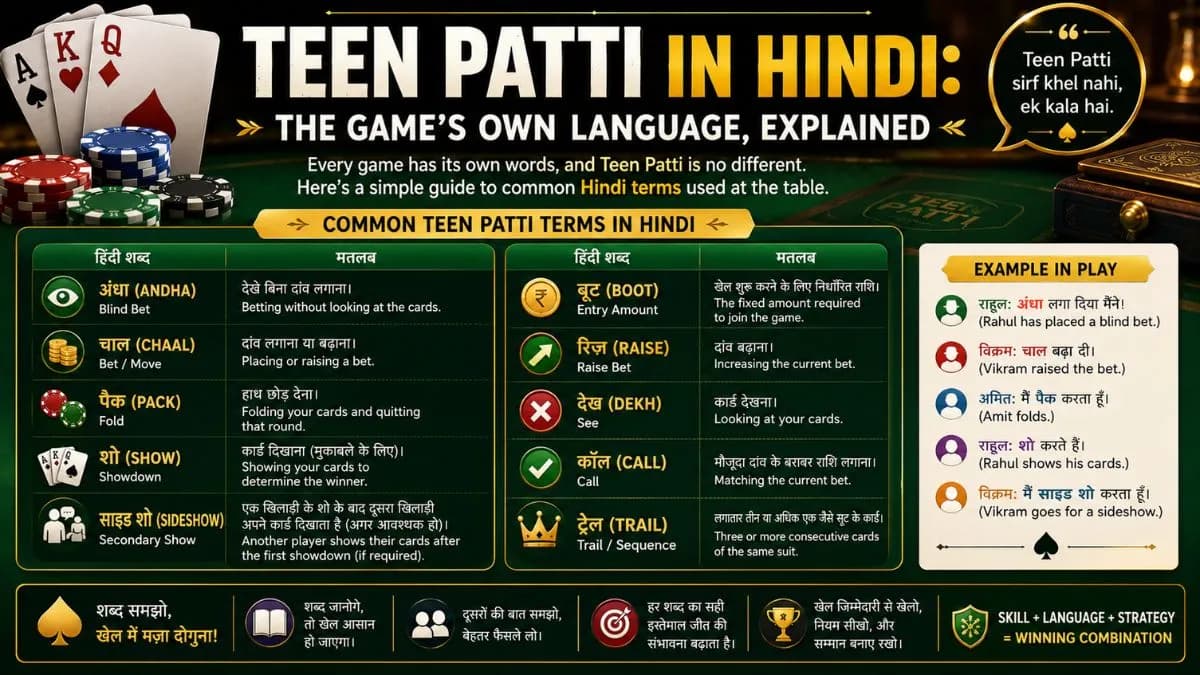
Teen Patti is a Hindi name — तीन पत्ती, 'three cards' — and at most family tables the game has always been played in Hindi. Yet nearly every written guide, including the rest of this site, explains it in English. This guide bridges the two: the game's core terms in Devanagari and English side by side, and a round narrated the way it actually sounds at the table. For fuller English definitions of each term, our terms glossary goes deeper.
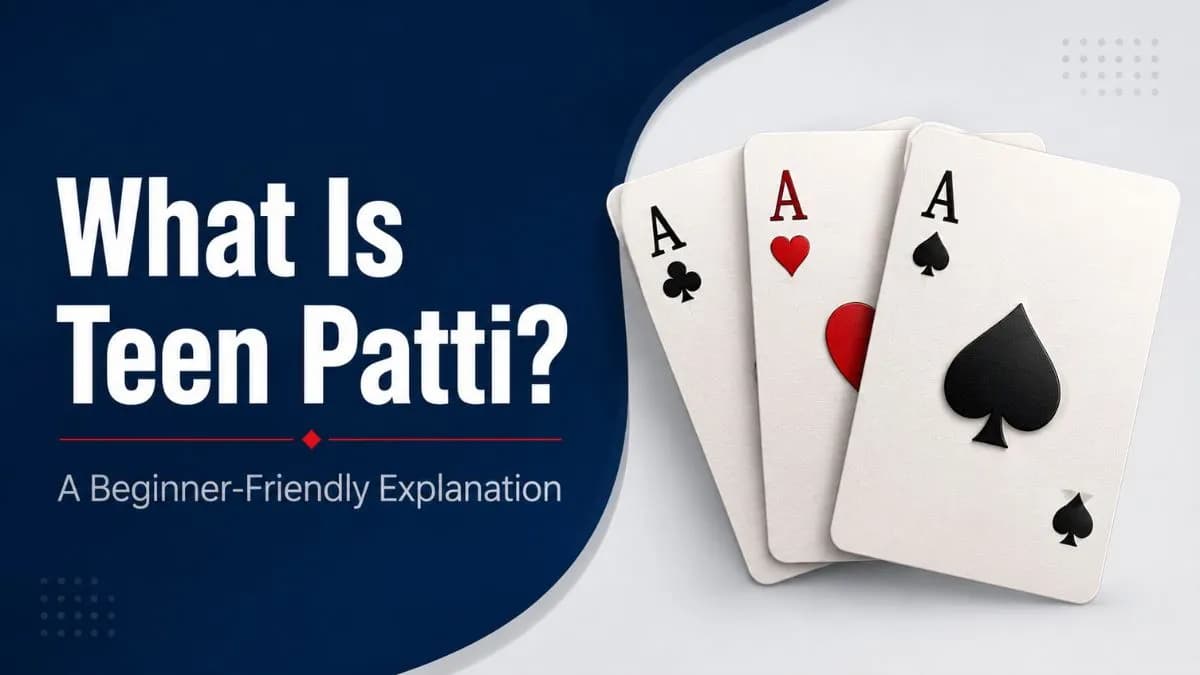
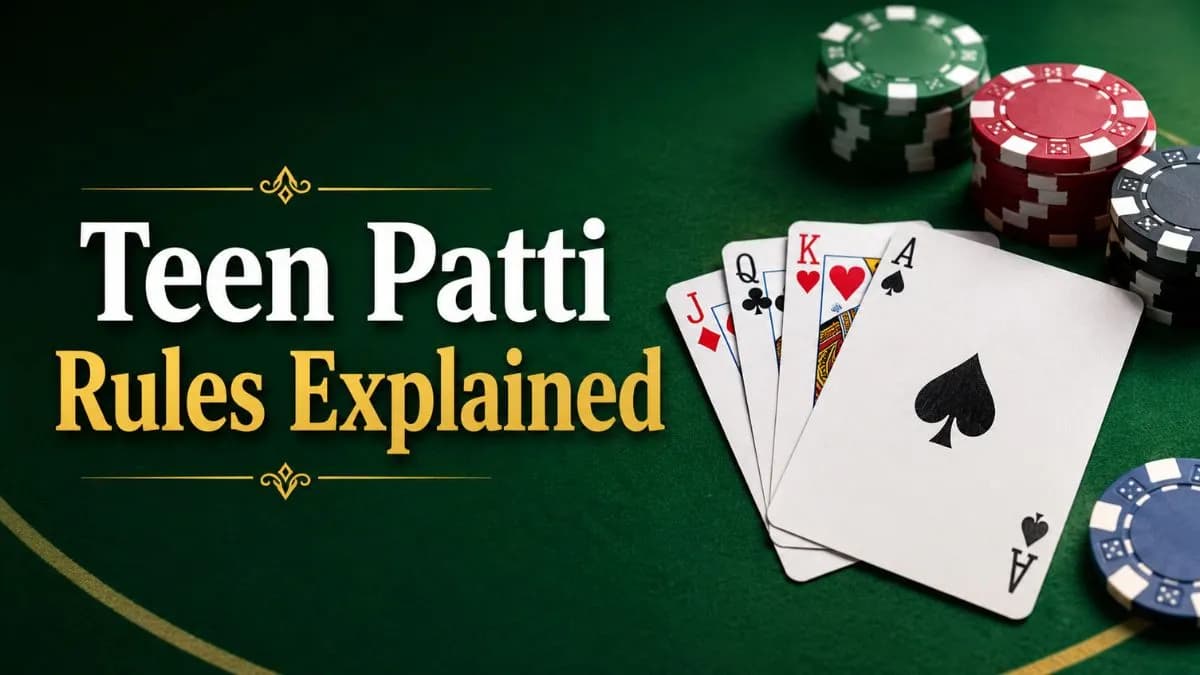
If you arrived here searching for how to play — teen patti kaise khelte hain (तीन पत्ती कैसे खेलते हैं) — the short answer follows, and our full rules guide covers every step in detail.
The basics, in both languages
हर खिलाड़ी को तीन पत्ते मिलते हैं — every player receives three cards, face down. Before the deal, everyone contributes a fixed starting stake to the pot. Betting then moves clockwise: on your turn you pay to stay in the round, or you fold and are out. The last player standing wins the pot, or the final two compare cards and the higher hand — ऊँचा हाथ — takes it.
The game's signature choice is whether to look at your cards at all. Playing without looking is cheaper per bet and puts pressure on everyone who has looked — the whole character of Teen Patti flows from that one trade.
Betting terms
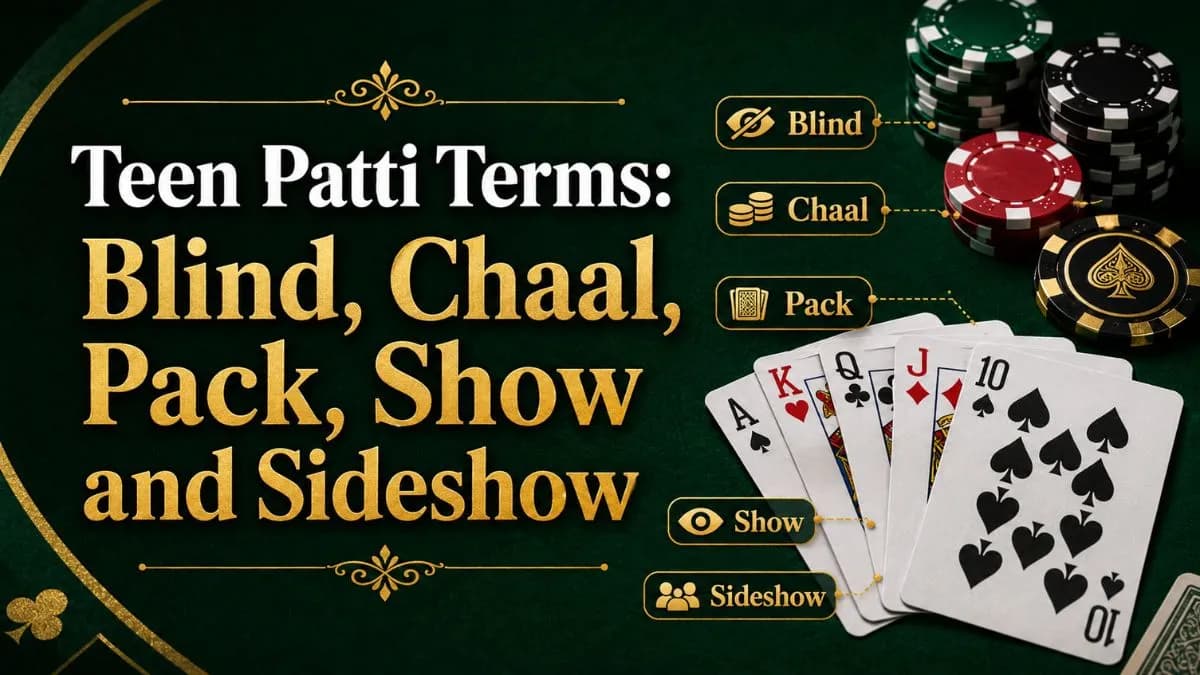
- Boot — बूट: the compulsory stake every player pays before the deal; it seeds the pot
- Blind — ब्लाइंड, traditionally अंधा (andhā, 'blind'): betting without looking at your cards, at the cheaper rate
- Seen — सीन / देखकर (dekhkar, 'having looked'): you have seen your cards and now pay double the blind rate to stay in
- Chaal — चाल (chāl, 'move'): the regular continuing bet of a seen player; apps show it as a button of the same name
- Pack — पैक: to fold — drop your cards and forfeit what you have already put in; app interfaces also say फोल्ड
- Show — शो: the final comparison when two players remain; the player who requests it pays for it
- Sideshow — साइड शो: a private comparison a seen player can request with the previous seen player; the lower hand packs
The hand names
At Hindi-speaking tables the hand names are mostly English words spoken as loanwords, which is also how apps label them. From strongest to weakest, as our hand rankings guide explains in full:
- Trail (three of a kind) — ट्रेल, also ट्रायो (trio): तीन एक जैसे पत्ते, three cards of the same rank
- Pure sequence — प्योर सीक्वेंस: three consecutive cards, एक ही रंग के — all in one suit
- Sequence — सीक्वेंस, sometimes रन (run): three consecutive cards in mixed suits
- Colour — कलर: three cards of one suit that are not consecutive; रंग (rang) is the Hindi word for suit
- Pair — पेयर / जोड़ा (joṛā, 'pair'): two cards of the same rank plus one other
- High card — हाई कार्ड: none of the above; the highest card decides
A note on regional slang
Home tables across India carry their own slang beyond this list, and it varies enough by region that we will not guess at it here. Where a regional term exists that we have not verified, this site uses the standard English word — which is what most apps display in any case.
A round, as it sounds
Here is a round in table language. Everyone pays the boot (बूट). Cards go around — पत्ते बँट गए. Two players look at their cards; one stays अंधा. The blind player bets the minimum; the seen players must each pay double or say पैक. Someone raises — चाल बढ़ गई, the stake has gone up. A seen player asks the player before them for a साइड शो; it is accepted, and the lower hand packs. Two players left: one pays for the शो, the cards turn over, and ऊँचा हाथ takes the pot.
Every mechanic in that paragraph is covered step by step in our rules guide; the glossary above is just the soundtrack.
Hindi in apps
Many Teen Patti apps offer Hindi or Hinglish interface options, though buttons and hand names usually stay in English or transliterated Hindi whatever the setting. Knowing both vocabularies means no table can confuse you. One caution consistent with the rest of this directory: we have not independently verified the language support of the specific apps listed here — check an app's own settings rather than relying on store descriptions.
This article is informational only and is not legal or financial advice. This website is an independent directory: it does not operate games, take bets, or process payments. See our editorial policy for how content is researched and updated.