
Teen Patti Basics
"Teen Patti Tricks" Claims: What's Actually True
Guaranteed-trick claims don't hold up. Here's what's genuinely skill in Teen Patti (reading opponents, bankroll management) vs what's pure chance.
Updated 29 October 2026
Safety and Privacy
Published 15 November 2026 · Updated 15 November 2026

"Is Teen Patti rigged?" is one of the most common questions asked about real-money card apps, usually after a losing streak that feels statistically unlikely. The honest answer has two parts: a shuffle that feels unlucky is not evidence of rigging — losing streaks are an expected feature of randomness, not a sign of it failing — but the concern itself is legitimate, because a dishonest shuffle is technically possible and you, as a player, cannot see the code running on someone else's server. This guide explains how shuffle/RNG fairness is normally verified in the industry, what a fairness certificate actually claims, and what you can realistically check yourself. We have not independently verified the RNG, shuffle algorithm, or any fairness certificate of any specific app listed in our games directory — this is a general explainer of how the verification process works, not a claim about any one platform.
Every digital card game needs a way to produce unpredictable results, which is done with a Random Number Generator (RNG) — software that produces a sequence of numbers with no detectable pattern, used to decide the order of a virtual deck before each hand. A well-implemented RNG is not "random" in a magical sense; it is a deterministic algorithm seeded with unpredictable inputs (timing, hardware noise, or a cryptographic seed) designed so that no outside party, including the operator's own staff without special access, can predict or influence the next deal. The quality of that seeding and algorithm is exactly what separates a fair shuffle from a riggable one — and it's invisible from the player's side of the screen.
In regulated gambling markets, operators commonly submit their RNG to an independent testing lab — organizations such as GLI (Gaming Laboratories International) or iTech Labs are frequently cited in the industry — which runs statistical tests against the output and issues a certificate stating the RNG passed those tests at the time it was tested. A certificate is a snapshot, not a permanent guarantee: it says nothing about code shipped after the test, and it is only meaningful if the lab is real, independent, and the certificate can be traced back to it (ideally with a certificate number you can look up, not just a logo on a page). Many apps in the Teen Patti / rummy app category operate outside formally regulated frameworks and do not publish any such certificate at all — the absence of one is not proof of rigging, but it does mean you are relying on the operator's word rather than independent verification.
A separate approach, more common in crypto-native gambling platforms than in mainstream Teen Patti apps, is "provably fair" design: the server commits to a hashed, unchangeable version of the shuffle before the round, and after the round it reveals the seed so you can mathematically verify the shuffle wasn't altered after you placed your bet. This is a genuinely different (and in principle stronger) guarantee than a lab certificate, because it lets any individual player verify a specific hand rather than trusting a one-time industry test. It is not something we have seen documented for the apps covered on this site, and we are not claiming any of them use it — it's included here because the term appears in searches about Teen Patti fairness and is worth knowing what it actually requires (a published, checkable seed-reveal mechanism) versus what it doesn't (a marketing phrase with no mechanism behind it).
A string of losses, even a long one, is expected behavior from genuine randomness and is not, by itself, evidence of a rigged shuffle; see our hand probabilities guide for how often strong hands actually occur. What a losing streak legitimately should trigger is the bankroll-management discipline covered in our tricks-truth myth-busting guide and our responsible gaming guide — deciding in advance how much you're willing to lose and stopping at that point — rather than a conclusion about fairness either way.
None of this is a verdict on any specific app's fairness, including any listed in this directory — we have not tested any app's RNG or traced any certificate ourselves, and no outside party can fully verify server-side code without lab access. Treat the presence of a real, checkable certificate as a meaningfully better signal than its absence, treat "provably fair" as a specific technical claim rather than a marketing phrase, and treat an ordinary losing streak as what it usually is: randomness, not rigging. 18+ only; real-money gaming carries financial risk regardless of how fair the shuffle is.
This article is informational only and is not legal or financial advice. This website is an independent directory: it does not operate games, take bets, or process payments. See our editorial policy for how content is researched and updated.
Teen Patti Basics
Guaranteed-trick claims don't hold up. Here's what's genuinely skill in Teen Patti (reading opponents, bankroll management) vs what's pure chance.
Updated 29 October 2026
Safety and Privacy
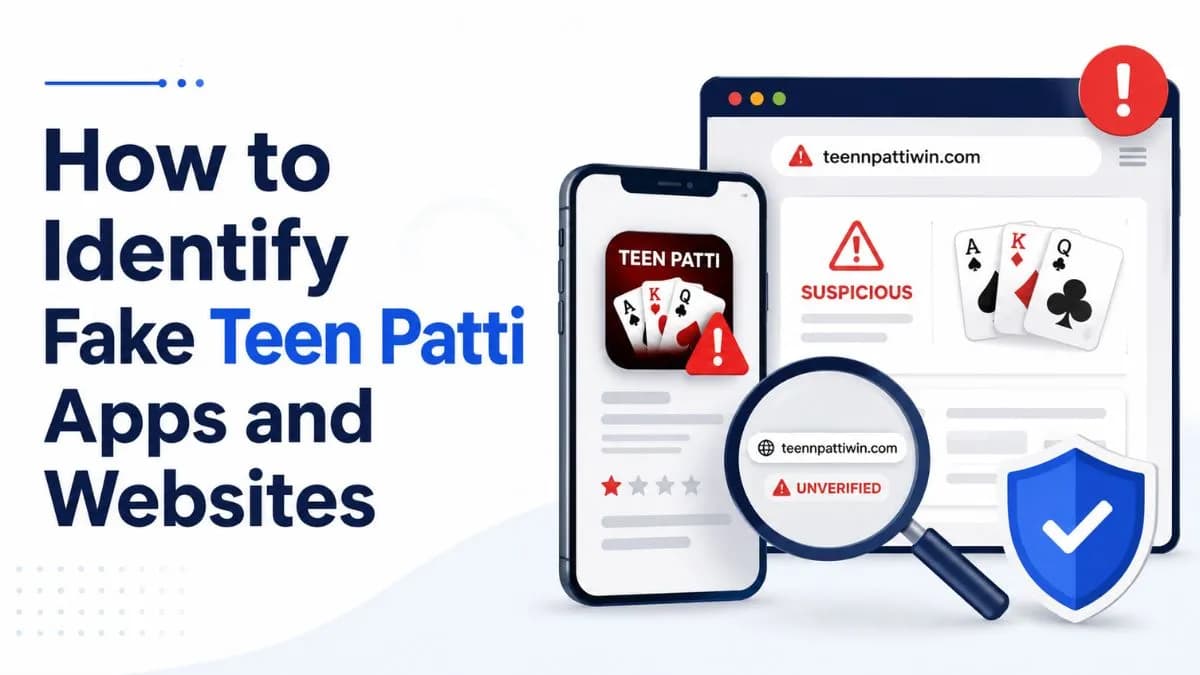
Cloned icons, lookalike names, tampered APKs, and impersonation pages — the common shapes of fake Teen Patti apps and how to spot each one.
Updated 17 July 2026
Safety and Privacy
"Unlimited chips" Teen Patti mod APKs are a common malware vector. Here's what a mod APK actually is, and why the claim itself is the red flag.
Updated 22 October 2026

Legal and Industry Updates
Is Teen Patti skill or chance under Indian law? A plain-language look at how courts and states treat card games. Not legal advice.
Updated 14 October 2026