Quick answer: Teen Patti ("three cards" in Hindi) is a popular South Asian card game widely believed to descend from the British three-card game Brag, which is itself related to older poker-type games. No single inventor or exact date is documented.
Teen Patti is so familiar in Indian homes that its beginnings are easy to forget. The honest answer is that nobody knows exactly where it started, but historians and card-game writers agree on a general picture.
What the name means
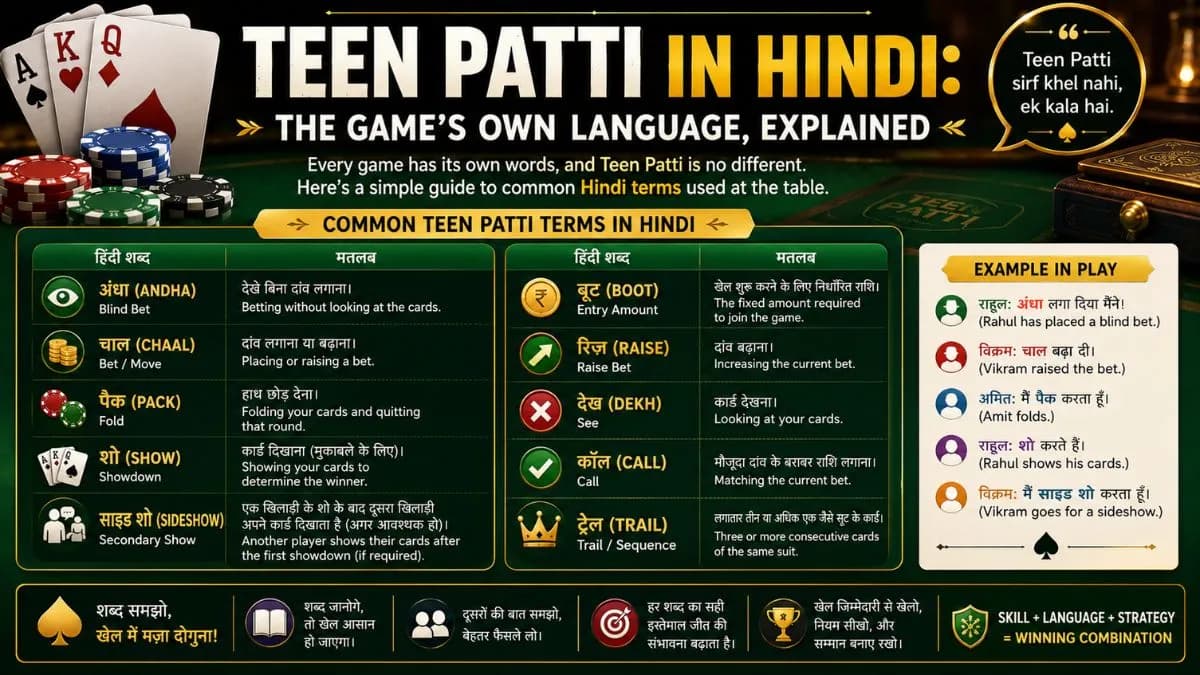
In Hindi, teen means three and patti means leaf, a word used for a playing card. So "Teen Patti" is literally "three cards". It is also written as "3 Patti" or "Teenpatti". For how the game's own vocabulary works, see Teen Patti in Hindi.
The likely ancestry
Teen Patti is commonly said to descend from Brag, a three-card betting game played in Britain for centuries, with relatives in older European and Persian card games. Brag shares the core features: three-card hands, a ranking led by three of a kind, and bluff-driven betting.
How the game arrived in India is not documented in detail. The most common account is that card games spread through trade and the colonial period, then took on local rules and vocabulary.
Teen Patti's relatives: a quick family tree
| Game | Where it is associated | Link to Teen Patti |
|---|
| Brag | Britain | Often cited as the closest ancestor; three-card hands, three of a kind on top, bluffing |
| Three Card Poker | Casinos | A modern casino game with a similar three-card hand ranking, though the ranking differs in places |
| Poker | Worldwide | A wider family of betting games; Teen Patti is often called "Indian poker" |
| Local variations | South Asia | Muflis, AK47, Joker and many more |
These links show a shared lineage of betting on three-card hands. They do not prove a single straight line of descent, and card historians still debate details.
Why there is no inventor
Card games evolve gradually. Rules are passed on by players and changed along the way, so there is rarely a single creator or date. Be cautious about any page that names a specific inventor or year without a source.
What we can and cannot say
- We can say that the name means "three cards", that the game is closely related to Brag, and that it spread through South Asian family and festival culture.
- We cannot say who first played it, in which year, or exactly how it travelled.
- We should be cautious about stories that connect it to specific historical figures. These are usually told as folklore rather than documented.
How it became a household game
- Simple rules: three cards and a short ranking are easy to learn. Start with what Teen Patti is.
- Short rounds: a hand takes a few minutes.
- Social play: it became a fixture at family gatherings, especially around festivals such as Diwali.
- No special equipment: a standard deck is enough.
Why the rules differ from poker
Teen Patti keeps a three-card hand and ranks trails above pure sequences, the opposite of poker's straight-flush-first logic. The usual explanation is that the ranking was fixed by tradition and simplicity: a trail is easy to recognise and is the hand most players remember as "the best". See trail vs pure sequence, and for more on how the two games differ, Teen Patti vs poker.
How the game developed locally
Players invented variations that changed the rules or ranking, including Muflis, AK47 and Joker. See all of them in common Teen Patti variations. The game also developed its own terms such as blind, chaal and sideshow, covered in Teen Patti terms explained.
Knowing the background explains why there are so many rule variations. A game that grew through families rather than a central rulebook develops local differences, such as the A23 ranking or optional rules like sideshow. When rules differ, the table's rules are always the final word.
This article is informational only and is not legal or financial advice. This website is an independent directory: it does not operate games, take bets, or process payments. See our editorial policy for how content is researched and updated.